



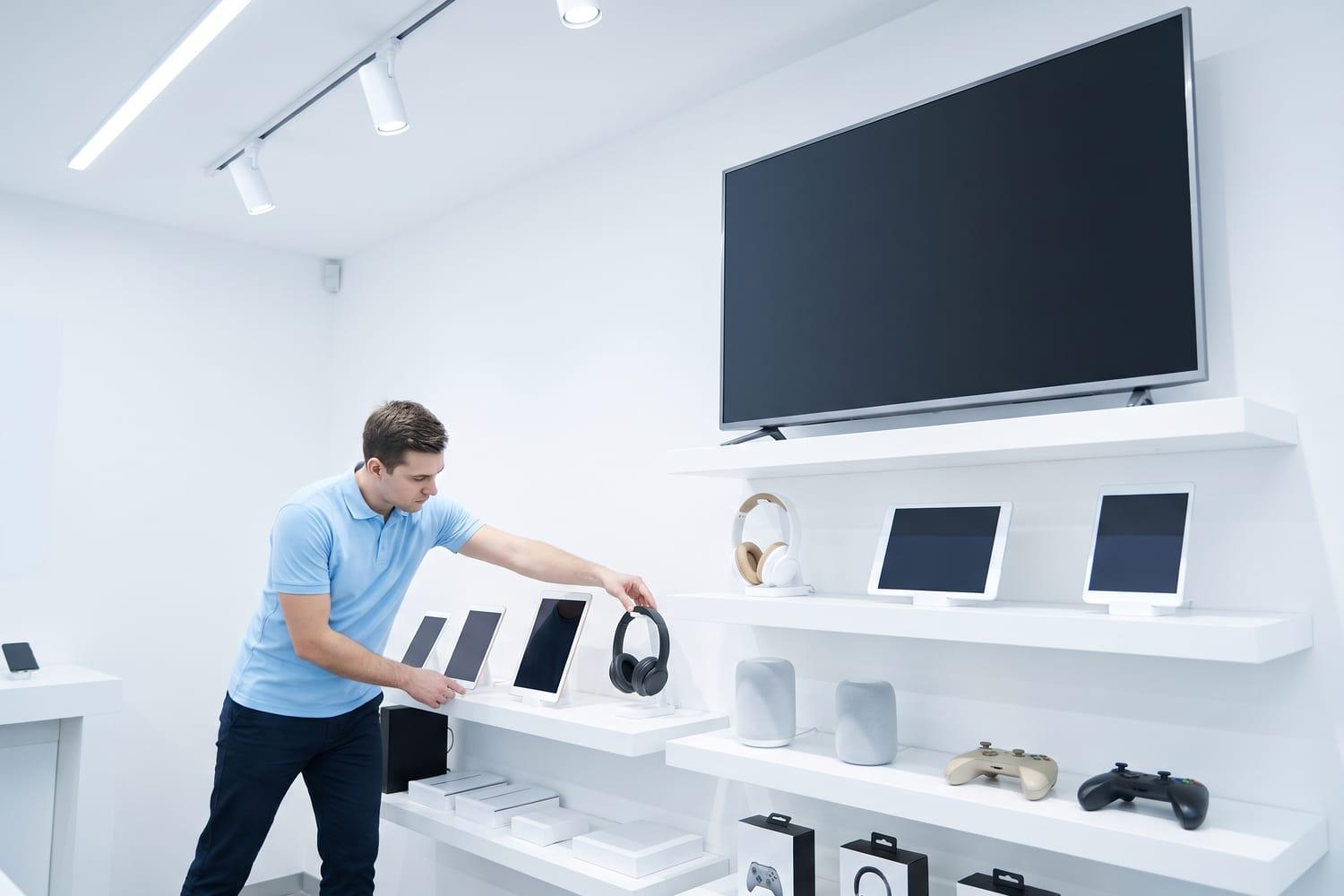
Consumer electronics wholesale for retailers works business to business: a registered retailer opens a B2B account with a distributor, requests a quote by part number, condition and quantity, and confirms a sales order before payment and dispatch. PHONIX, a global B2B sourcing platform specialized in wholesale technology distribution, quotes TVs, tablets, peripherals and gaming in 24 hours.
Key takeaways
- Consumer electronics distributors that work B2B sell to retailers, resellers and companies. PHONIX never sells to individual consumers.
- Four categories cover most of a consumer electronics floor: TV and home entertainment, tablets, peripherals and gaming peripherals.
- A retail assortment is planned by customer and price tier, not by brand, and every line is identified by its exact part number.
- Products are offered new and refurbished, according to availability in each category and market, and the quote states the condition of every line.
- Register on the PHONIX B2B platform for your country and request a quote in 24 hours.
What consumer electronics do retailers buy wholesale?
A consumer electronics retailer sells to households, students, gamers and small offices, one unit at a time. Its buying decisions are different from those of a company equipping its own staff: the product has to look good on a shelf or a product page, it has to be easy to explain at the point of sale, and it has to sell before the next model arrives.
At PHONIX, the categories a retailer usually quotes through one B2B account are these:
| Category | Typical products | Typical retail customer | Where to browse |
|---|---|---|---|
| TV and home entertainment | TVs, sound bars, projectors and screens, streaming devices | Households upgrading the living room, small businesses with displays | TV and home entertainment on the PHONIX USA B2B platform |
| Tablets | Tablets for entertainment, study and work | Families, students, professionals on the move | Tablets on the PHONIX USA B2B platform |
| Peripherals | Monitors, keyboards and mice, headsets, webcams, speakers, printers and supplies | Home offices, students, small offices | Peripherals on the PHONIX USA B2B platform |
| Gaming peripherals | Gaming mice, headsets, controllers, gaming monitors | Gamers and buyers of gifts | Gaming peripherals on the PHONIX USA B2B platform |
PHONIX works with 23+ brands, including Samsung, LG, Sony, Apple, Google, Microsoft, HP, Lenovo, ASUS and Acer. The models available change by category and market, which is why each quote lists the specific part numbers on offer. For a complete view of what the platform covers, see the product categories.
How is sourcing for retail different from sourcing for a company?
A company that buys forty identical monitors cares about consistency and delivery to one address. A retailer that buys forty monitors cares about how they will sell: which sizes move faster, whether the box survives the sales floor, whether the product page can answer the customer's questions, and what happens when a customer returns a unit.
That changes what you ask your distributor:
- Retail packaging. For new products, you need the unit in its original retail box, with the accessories and documentation the customer expects to find inside.
- Product information. Your listings and shelf tags need exact specifications. The part number lets you take the manufacturer's data sheet and match it to the unit you will receive.
- Breadth before depth. A retailer usually needs several sizes or price points of the same product type, in smaller quantities each, rather than a large quantity of one model.
- Repeatability. If a model sells well, you want to reorder the same part number, so ask early how continuity is handled for the lines you plan to keep.
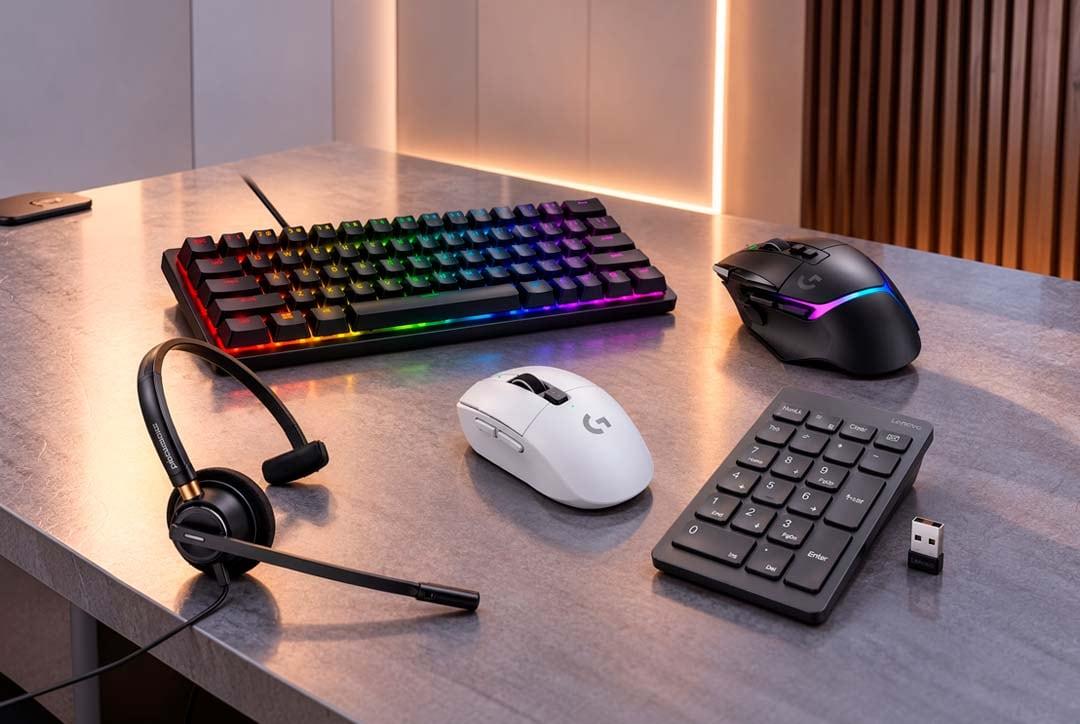
How do you build a good, better, best assortment?
Most consumer electronics retailers organize each category in three tiers. The entry tier brings traffic, the middle tier carries most of the sales, and the upper tier lifts the average ticket and shows the customer what is possible. The tiers are defined by specifications, not by brand alone.
- TVs: screen size, resolution, panel type and smart platform separate one tier from the next.
- Tablets: storage, screen, processor and whether the model includes cellular connectivity.
- Monitors: size, resolution and refresh rate, with office models in one tier and gaming models in another.
- Gaming peripherals: wired or wireless connection, sensor and switch quality for mice and keyboards, audio quality and comfort for headsets.
Start each category with a small range that covers the three tiers, measure what sells, and adjust the next order. Quoting several brands side by side for the same specification makes it easier to fill each tier with the option that fits your customers.
What should a retailer check in each category before ordering?
Each category has details that decide whether a unit sells or comes back.
TVs and home entertainment. Confirm that the TV works with the digital broadcast standard and the power supply of your market, and that its smart platform offers the apps your customers use in their language. Remember that TVs are bulky: freight and handling change their real cost more than for smaller products. Sound bars, streaming devices and projectors sell to the same customer, so quote them together.
Tablets. Check the operating system and how long the model is expected to receive updates, the storage, and whether the unit is Wi-Fi only or includes cellular connectivity compatible with the networks in your country. Confirm the charger plug for your market and the language options.
Peripherals. Keyboards must have the right layout for your customers, for example US English or Latin American Spanish. Monitors need the right connectors for the computers your customers own. Printers sell better when you also carry their supplies, so the customer comes back.
Gaming peripherals. Check compatibility with the platforms your customers play on, the connection type, and whether software or region settings affect how the product works in your market. For gaming monitors, refresh rate and size define the tier.
If monitors are one of your core lines, see the guide to wholesale monitors for resellers.
New or refurbished: what can a consumer electronics retailer sell?
PHONIX offers new and refurbished products, according to availability in each category and market. New units fit most retail floors, gift seasons and customers who expect a sealed box. Refurbished units can serve price-sensitive customers and secondary channels, provided the customer knows exactly what they are buying.
Treat new and refurbished units of the same model as two different products, with separate listings and separate shelf tags. Ask the quote to state the condition of every line, and ask how cosmetic condition and included accessories are described for refurbished units, since those details shape what you can promise at the point of sale.
How do you plan purchases around retail seasons?
Consumer electronics sales are seasonal. Back to school drives laptops, tablets and peripherals. Year-end holidays drive TVs, gaming and gifts. Large sporting events tend to move TVs and sound bars. The exact calendar depends on your market, but the principle is the same everywhere: the assortment has to be on your sales floor before the demand peaks, not when it starts.
A few practices help:
- Quote early. Request quotes for seasonal lines well before the season, so you can compare options and confirm the sales order in time.
- Check the ETA for your destination. Each PHONIX platform shows the ETA, which depends on the country, the destination and availability.
- Split the season into two orders. A first order covers the expected demand, and a second one repeats the lines that sold.
- Arrange payment terms in advance. PHONIX accepts bank transfer and card, and offers credit lines for qualified clients, with conditions that depend on each operation. Having a line in place before the peak gives you room to buy without waiting on your cash flow.
How do you order consumer electronics from PHONIX, step by step?
The process is the same in every PHONIX operation:
- Register your company on the PHONIX B2B platform for your country.
- Validation and B2B access. The team validates the company and enables access to the B2B catalog.
- Explore the catalog and build the order, either with the cart on the platform or with a sales executive.
- Sales order and payment. PHONIX generates and confirms the sales order (SO), and payment is coordinated.
- Dispatch according to availability, destination and logistics conditions.
- Tracking of the order from the platform.
For more detail on registration and payment, see how to buy at PHONIX.
Which PHONIX platform should a retailer register on?
PHONIX has four operations: the United States (Miami, headquarters), Peru (Lima), Colombia (Medellín) and Dubai, and it distributes internationally from those operations. Retailers in the United States, and retailers in countries without a local PHONIX operation, register on the PHONIX USA platform, where the TV, tablet, peripheral and gaming categories above are published. Retailers in Peru and Colombia can register on the platform of their country, and buyers in the UAE work with the Dubai operation through phonix-dubai.com.
If you import into your country, confirm duties, taxes and any product requirements with your customs broker before the first order, and compare landed cost, not only unit price.
What mistakes cost consumer electronics retailers the most?
- Buying by brand instead of by customer. A range that covers the three tiers of one category sells better than many models of a single brand.
- Ignoring market compatibility. A TV, tablet or keyboard that does not match your market's standards, plugs or language is hard to sell at any price.
- Ordering too late for the season. Demand peaks do not wait for shipments.
- Mixing conditions on the shelf. New and refurbished units of the same model need different tags and different listings.
- Leaving out the accessories. Sound bars, cases, chargers, mice and supplies raise the value of each sale and bring customers back.
Frequently asked questions
Where can retailers buy consumer electronics wholesale?
From a B2B distributor that opens accounts for registered companies. At PHONIX, you register your business on the platform for your country and request a quote in 24 hours.
Which consumer electronics distributors work with small retailers?
B2B distributors that sell to registered businesses, regardless of size. PHONIX works with resellers, retailers, integrators, distributors and companies, and the first step is to register your company.
Can one wholesale order mix TVs, tablets and gaming peripherals?
Yes. One B2B account covers several categories, so a single quote can include TVs, tablets, peripherals and gaming peripherals, each line with its part number and condition.
Does PHONIX sell consumer electronics to individuals?
No. PHONIX sells only to businesses: resellers, retailers, integrators, distributors and companies.
Does PHONIX offer refurbished consumer electronics?
Yes, according to availability in each category and market. The quote states the condition of every line.
Ready to fill your sales floor with consumer electronics?
Register your company on the PHONIX USA B2B platform or on the platform for your country, explore the categories and build your first order. If you prefer to start with a conversation, contact the PHONIX team and request a quote in 24 hours.