




To choose a technology wholesaler in Latin America, run six checks before your first order: the brand portfolio, B2B-only access, payment and credit terms, international logistics to your country, sales support, and a clear split between new and refurbished products. If a supplier fails two or more of these checks, keep looking.
Key takeaways
- A technology wholesaler works only with businesses: resellers, retailers, integrators, distributors and corporate buyers.
- Compare the total landed cost in your country, not the unit price: freight, insurance, duties and taxes change the math.
- Every quote should state brand, model, quantity and condition (new or refurbished).
- Payment and credit terms should be in writing, and they depend on each operation.
- In Latin America, buy through the operation that serves your country.
What is a technology wholesaler, and what is it called in each country?
A technology wholesaler is a company that supplies other companies in volume: resellers, retailers, systems integrators, regional distributors and corporate procurement teams. It does not sell to end consumers. Its job is to bring many brands together in one channel and deliver what its customers need to resell or to run their operations.
If you source across Latin America, you will see the same kind of supplier under different names, and knowing them helps you find offers and compare suppliers in each market:
- In Argentina and Uruguay, buyers search for a mayorista de informática (IT wholesaler).
- In Mexico and Peru, the usual term is mayoristas de cómputo (computer wholesalers).
- In Colombia, buyers talk about mayoristas de tecnología and computer suppliers.
- Across the region, distribuidor de tecnología (technology distributor) is common too.
The label changes, but the checks do not. An IT wholesaler in Montevideo and a computer wholesaler in Lima are evaluated with the same questions, and you should expect the same quality of answers from both.
What should you check before choosing a technology wholesaler?
This table sums up the six areas to review before the first order, what to ask in each one, and which answer should make you pause.
| Check | What to ask | Red flag |
|---|---|---|
| Brand portfolio | Which brands and categories do you carry for my country? | Promises "every brand" without showing a catalog |
| B2B access | How do you validate companies, and what access do you grant? | Sells to anyone, with no company validation |
| Payment and credit | Which payment methods do you accept, and how do I qualify for credit? | Terms that exist only verbally |
| International logistics | How do you ship to my destination, and where do I see the estimated date? | Fixed dates without knowing destination or availability |
| Support | Who handles my account, and how do I track each order? | No sales executive and no order tracking |
| New and refurbished | How does the quote state the condition of each product? | Quotes that do not state condition |
The sections below explain each check and how PHONIX handles it. PHONIX is a global B2B sourcing platform specialized in wholesale technology distribution, with more than 20 years in the industry.
Which brands and categories should a wholesaler's portfolio cover?
Portfolio comes first because it decides how many suppliers you will need. If every brand forces you to open a separate account, you multiply quotes, invoices, shipments and reconciliations. A wholesaler with a broad portfolio lets you consolidate purchasing and negotiate with a single counterpart, and you feel that in the admin work every month.
Ask three things: which brands they carry, which categories they cover for each brand (laptops, desktops, components, peripherals, monitors), and whether the offer changes depending on the country you buy from. That last point matters: technology availability varies by market, and a catalog built for one country may not apply to yours.
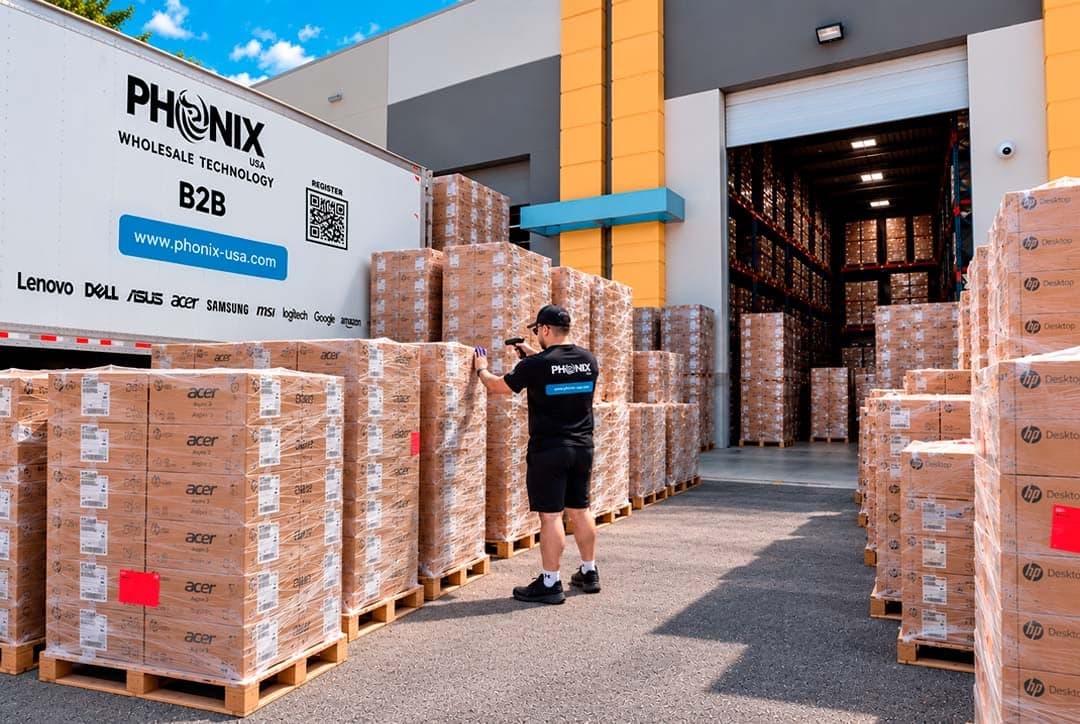
PHONIX works with 23+ brands, including HP, Lenovo, Dell, ASUS, Acer, Apple, Samsung, Microsoft, Intel, AMD, Sony, LG, MSI, Gigabyte, Alienware and Google. You can see how the lines are organized on the PHONIX categories page.
How does B2B access work, and who can buy?
A serious wholesaler validates its customers. It asks for company details, reviews them, and only then grants access to B2B terms. It can feel like paperwork, but it protects everyone: it keeps the channel from competing with its own customers by selling to end consumers on the same terms.
PHONIX is B2B only, serving resellers, retailers, integrators, distributors and businesses. It does not sell to end consumers. The process is the same in every operation:
- Register your company on the B2B platform for your country.
- Validation and B2B access to the platform.
- Catalog and order: browse the catalog and build your order from the cart or with a sales executive.
- Sales order (SO): PHONIX generates and confirms the sales order, and payment is coordinated.
- Dispatch based on availability, destination and logistics conditions.
- Tracking of the order from the platform.
See the details in how to buy from PHONIX and in the buying process on the PHONIX USA B2B platform. Have your company details ready before you register: a complete registration from the start avoids back and forth during validation.
What payment and credit terms should a wholesaler offer?
In the wholesale channel, payment does not work like a retail checkout. Wholesalers usually accept bank transfer, sometimes card, and offer credit lines to customers who meet certain requirements. What you are looking for is clarity: accepted payment methods, invoicing currency, when the order is confirmed, and what your company needs to qualify for credit.
At PHONIX you can pay by bank transfer or card, and credit lines are available for qualified customers. Terms depend on each operation, so ask about the ones that apply to the platform you buy from.
Two practical tips:
- Get the terms in writing before the first order. A condition that was only mentioned on a call is hard to claim later.
- Build a track record. Trade credit is based on the relationship. Starting with orders paid by transfer, and paying as agreed, is the most direct path to a credit line.
How do you evaluate international logistics to your country?
For a Latin American buyer, the unit price tells only part of the story. What decides whether an order is profitable is the total landed cost in your country: price, freight, insurance, duties, import taxes and your customs broker's fees. A wholesaler with better logistics can come out ahead even when its unit price is higher.
When you evaluate logistics, ask:
- Where your order ships from and who coordinates international transport.
- Which delivery term the quote uses, so you know at what point responsibility passes to your company.
- Where you check the estimated delivery date and how you track the shipment.
- Which documents travel with the shipment, so your customs broker can work without delays.
PHONIX has four operations, in the United States (Miami, headquarters), Peru (Lima), Colombia (Medellín) and Dubai, and distributes internationally from them. Dispatch depends on availability, destination and logistics conditions. The estimated time of arrival (ETA) is shown on each platform, because it changes with the country, the destination and availability. Be wary of any supplier that promises a fixed date without knowing where your order is going.
What support should you expect before and after the sale?
You can judge support before you buy. How fast and how precisely a wholesaler answers a quote request usually tells you how it will respond when there is a problem with a shipment or a unit.
Look for three things: a sales executive who knows your account, complete quotes (brand, model, quantity and condition), and a place to check the status of each order without chasing anyone by email. Before the first order, also ask how warranty is handled for each brand and each product condition, and who you contact if something arrives damaged.
At PHONIX you can request a quote in 24 hours, place orders from the cart or with a sales executive, receive a confirmed sales order, and track every order from the platform.
Should you buy new or refurbished products?
It depends on your customer. New products are the natural choice for retail and for projects where the end buyer requires first-hand equipment. Refurbished units make sense for corporate fleets, education, volume refreshes and segments where budget matters more than having the latest model.
What matters is that the difference is clear on every quote. The same model, new and refurbished, is two different products, with different pricing, warranty and customer expectations. Ask how refurbished units are graded and which warranty applies in each case.
PHONIX offers new and refurbished products, depending on availability in each category and market.
Which red flags should you avoid?
- No company validation. If anyone can buy on the same terms, you are not dealing with a B2B channel.
- Incomplete quotes. Without the exact model and condition, you do not know what you will receive.
- Verbal terms. Payment, credit and warranty have to be in writing.
- Promised dates without data. A serious delivery date depends on destination and availability.
- No tracking. If you have to chase someone to find your order, the problem grows with volume.
By country: which PHONIX platform is right for you?
PHONIX serves Latin America through three B2B platforms. Register on the one for your country:
| Country | Platform | Operation that serves you |
|---|---|---|
| Peru | PHONIX Peru B2B platform | Lima |
| Colombia | PHONIX Colombia B2B platform | Medellín |
| Rest of Latin America | PHONIX USA B2B platform | Miami, with international distribution |
If your company buys from Mexico, Central America or the Southern Cone, the entry point is the PHONIX USA platform, with international distribution from Miami. For Dubai and the United Arab Emirates, PHONIX has its own operation in Dubai.
How do you start working with PHONIX?
Register your company on the B2B platform for your country, complete validation and browse the catalog with B2B access. If you would rather start with a conversation, request a quote from PHONIX: PHONIX quotes in 24 hours.
Frequently asked questions
How do you choose a reliable technology wholesaler?
Check that it validates your company, that its portfolio covers the brands you sell in your country, that payment and credit terms are in writing, and that you can track every order. If it fails two or more of these, look for another option.
What is the difference between an IT wholesaler and a technology distributor?
In practice they are different names for the same B2B channel. Buyers in Argentina and Uruguay say mayorista de informática, buyers in Mexico and Peru say mayorista de cómputo, and distribuidor de tecnología is used across the region.
Where can I buy wholesale laptops for Latin America?
From a technology wholesaler that works only with businesses. With PHONIX, companies in Peru and Colombia buy on the B2B platform for their country, and the rest of Latin America buys on the PHONIX USA platform, with international distribution from Miami.
Can an individual buy from a technology wholesaler?
Not at PHONIX. PHONIX sells only to businesses: resellers, retailers, integrators, distributors and corporate buyers.
Do technology wholesalers offer credit?
Many do, for qualified customers. PHONIX offers credit lines for qualified customers, along with bank transfer and card payments, with terms set by each operation.